
I Wrote a Novel About an Underwater Civilization. Then Congress Started Confirming My Plot.
How a YA Fantasy About Unidentified Submerged Objects, Deep-Ocean Anomalies, and Ancient Underwater Cities Collided with Real Congressional Testimony on Underwater Alien Bases
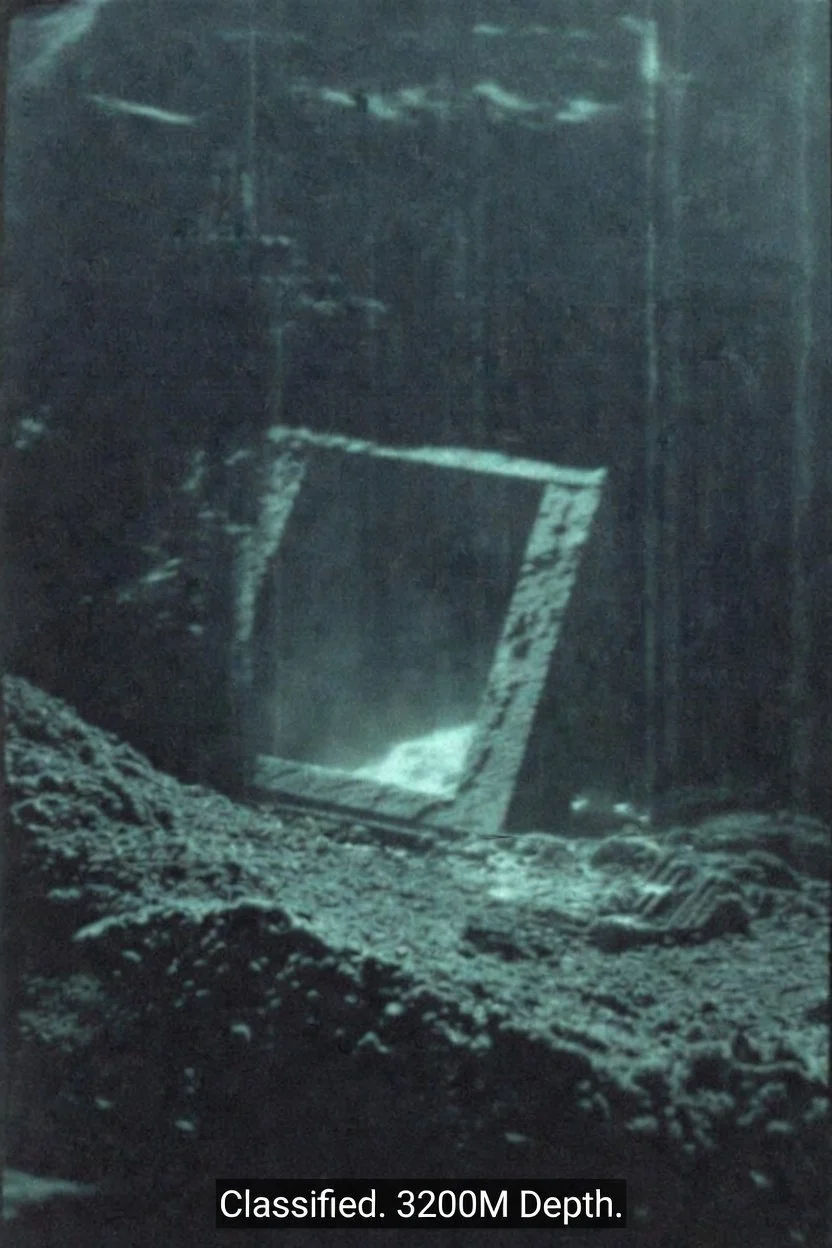
In 2020, I started writing a character named Veyla Plumb.
Veyla is thirteen years old. She lives in Sundance, Wyoming — about as far from the ocean as you can get in the continental United States. But she's obsessed with whales, specifically with tracking a pattern of mysterious whale deaths that nobody else seems to be connecting. She built a website called iheart52.com. She wrote programs to aggregate marine biology reports from around the world. She cross-referenced whale mortality data with ocean depth charts, acoustic anomaly logs, and satellite imagery.
What she found scared her.
The deaths were clustering in deep water, near coordinates that didn't match any known environmental hazard. Every dead whale she tracked was found above water deeper than 3,000 meters. No exceptions. No disease. No ship strikes. No toxins. Something was down there.
Veyla is a fictional character in my YA fantasy novel Amelia Moon and the Sundance Shadow. She's the best friend of my protagonist, Amelia Moon — a girl who discovers she's the last descendant of an ancient Atlantean civilization and must journey to an underwater city called Sophisis to claim a powerful artifact before her corrupted uncle can seize it. The novel is set in real Sundance, Wyoming, in the shadow of Devils Tower, and it blends small-town American life with deep mythology about what might be preserved beneath the ocean floor.
When I was building Veyla's research — her whale death maps, her acoustic data, her conspiracy-adjacent but data-driven analysis — I thought I was inventing a clever fictional framework. I was creating a transmedia companion website where Veyla's research would live as if it were real, letting readers discover the story through her eyes.
Then the real world caught up to my plot.
What Congress Says About Underwater Alien Bases and Unidentified Submerged Objects
In November 2024, the U.S. House Oversight Committee held a hearing titled "Unidentified Anomalous Phenomena: Exposing the Truth." The witnesses weren't conspiracy theorists posting on Reddit. They were a retired Navy Rear Admiral who once led NOAA, a former Department of Defense official, a former NASA administrator, and a journalist who had obtained classified documents about secret government programs.
Retired Rear Admiral Tim Gallaudet — the former administrator of the National Oceanic and Atmospheric Administration, the agency responsible for understanding our oceans — testified under oath. His statement included a direct reference to what are now being called USOs: Unidentified Submerged Objects. He stated that humanity is aware of objects interacting with us, and that this includes unidentified submerged objects in the ocean. He urged Congress not to turn a blind eye, but to face this new reality head-on.
This wasn't fringe speculation. This was the former head of NOAA, speaking under oath, in a congressional hearing, confirming that unidentified objects are operating in our oceans.
In January 2025, Representative Tim Burchett went further in a televised interview. He described being told by an unnamed admiral about a documented case involving an object moving underwater at speeds exceeding hundreds of miles per hour — an object described as roughly the size of a football field. For context: the fastest military submarine travels at approximately 35 knots. The fastest torpedo reaches around 60 knots. What Burchett described would be moving at speeds that are flatly impossible for any known human technology.
By September 2025, the House Oversight Committee's Task Force on the Declassification of Federal Secrets had listed USOs and underwater alien bases among its top investigative priorities. Military whistleblowers testified about encounters with objects that appeared to exceed existing weapons and technology capabilities. Legislation was introduced to protect UAP whistleblowers from retaliation.
The current state of the conversation in the United States Congress: something is operating in our oceans that we cannot identify, and certain elements of the government have been withholding information about it for possibly decades.
9,000 USO Sightings: The Enigma Database and Unidentified Submerged Objects Near U.S. Coastlines
Congressional testimony is one data stream. But it's far from the only one.
The Enigma app, launched in late 2022, has become the largest searchable civilian database for unexplained aerial and submersible phenomena. As of August 2025, Enigma had logged over 9,000 USO sightings within 10 miles of U.S. shorelines and major waterways. Roughly 1,500 of those reports specifically mentioned water, ocean, lake, or beach. Approximately 500 occurred within 5 miles of a coastline.
These aren't all blurry phone videos of lights in the sky. Some of the most compelling Enigma reports involve objects emerging from bodies of water or traveling beneath the surface. One widely cited entry captures mysterious underwater lights filmed from a boat off Fort Lauderdale, Florida.
The pattern that emerges from the Enigma data is striking: USO reports cluster along the Eastern Seaboard, the Gulf Coast, and the Pacific coast near Southern California — the same areas where the U.S. Navy has documented its own encounters with unidentified submerged objects.
The most famous of those Navy encounters is the USS Omaha incident. On July 15, 2019, crew aboard the USS Omaha — a littoral combat ship operating in restricted waters off San Diego — recorded a spherical object on their FLIR (forward-looking infrared) cameras. The object hovered above the water, maneuvered at speeds and angles that defied conventional aerodynamics, and then descended into the ocean. A submarine was dispatched to search for wreckage. None was found. The Pentagon confirmed the footage was authentic and that it was under review by the UAP Task Force.
Military analysts call this "transmedium" capability — an object that operates in both air and water without any discernible propulsion system, transitions between mediums without slowing down, and leaves no recoverable physical trace. Nothing in any nation's known arsenal can do this.
The Bloop, Julia, and NOAA's Unexplained Deep-Ocean Sounds
While the USO conversation has accelerated in recent years, the ocean has been producing anomalous acoustic signals for far longer.
In 1997, NOAA's Pacific Marine Environmental Laboratory recorded an extraordinarily powerful ultra-low-frequency underwater sound in the South Pacific. The sensors that captured it were more than 3,200 kilometers apart. The sound was louder than any known biological source and unlike anything in NOAA's catalog. Researchers named it "The Bloop."
The Bloop's coordinates placed the source at approximately 50°S, 100°W — a remote point in the Pacific, west of the southern tip of South America. By 2012, NOAA officially attributed the sound to icequakes, or ice calving from glacial movements. But the attribution came with caveats. The initial researchers noted that The Bloop's acoustic profile closely resembled biological sound production, with rapid frequency variations characteristic of marine life — but amplified to a scale that no known organism on Earth could produce. If it were biological, the animal producing it would need to be vastly larger than a blue whale.
The Bloop wasn't the only unexplained deep-ocean sound NOAA recorded. In 1999, hydrophones captured "Julia" — a strange cooing groan detected across the entire Equatorial Pacific autonomous hydrophone array, lasting nearly three minutes. Before that, in 1991, the "Upsweep" was detected — a seasonal, repeating low-frequency sound originating from the Pacific that is still being recorded today, more than three decades later, with no confirmed source. In 1997, "Slow Down" was captured — a sound descending in frequency over seven minutes, located near the Antarctic Peninsula. And "Train" — a steady hum from the Ross Sea, suspected to be an iceberg dragging across the seafloor.
Each of these sounds was initially unidentified. Each was eventually attributed, with varying degrees of confidence, to glacial activity. But the ocean covers 71% of the planet's surface. We have explored less than 5% of it. The hydrophone arrays that detected these sounds were designed during the Cold War to track Soviet submarines — they were repurposed for civilian science after the fall of the Soviet Union. NOAA's own acoustics program acknowledges that the deep ocean remains one of the least monitored environments on Earth.
When I built Veyla Plumb's fictional research, I used these real sounds as her foundation. Her character tracks acoustic anomalies in deep water that correlate with unexplained whale deaths. She references The Bloop, Julia, and the Upsweep by name. She notes that all of her whale death incidents occur above water deeper than 3,000 meters — the same depth threshold where NOAA's unexplained sounds originate.
I thought I was building an entertaining fictional conspiracy. Now I'm not entirely sure what I built.
Unexplained Whale Deaths and Deep-Ocean Acoustic Anomalies: The Real Data Behind the Fiction
Here's where my fiction starts brushing uncomfortably close to reality.
Unusual whale mortality events have been increasing globally for years. NOAA's own data shows that Unusual Mortality Events (UMEs) for large cetaceans have spiked in frequency since the early 2010s. While many are attributable to ship strikes, entanglement, or environmental factors like algal blooms, a subset of cases remains genuinely puzzling — whales found dead with no visible trauma, no toxins, no disease, and no obvious cause of death.
In Amelia Moon and the Sundance Shadow, Veyla tracks 47 such incidents. She maps them, analyzes the depth data, runs pattern recognition algorithms borrowed from an MIT open-source project, and discovers that the deaths cluster near deep-water coordinates where acoustic anomalies have been recorded. She cross-references her findings with USO sighting databases — and the overlap is statistically uncomfortable.
The fictional Veyla doesn't claim to have answers. She has questions. She presents data. She notes correlations that resist easy explanation. She writes things like: "Correlation is not causation — I know this — you can make the case that ice cream sales cause shark attacks — but hear me out."
That's the Veyla voice: rigorous but scared. Academic but teenage. Certain of her data and terrified of her conclusions.
And increasingly, it sounds a lot like the testimony coming out of congressional hearings about unidentified submerged objects and underwater alien bases.
Writing an Underwater Civilization Novel During the USO Disclosure Era
In my novel, beneath the ocean lies Sophisis — a city built by the ancient Atlantean civilization to preserve their most important knowledge and wisdom after they foresaw their own destruction. Sophisis isn't a ruin. It's a functioning repository of ancient technology, protected by trials that test worthiness, maintained by systems that have operated for millennia without human oversight. Amelia Moon must journey there to claim the Aetheris Stone, the only artifact capable of combating a spreading darkness that threatens both the underwater and surface worlds.
Sophisis operates on a bioelectric frequency system — a magic system rooted in the idea that every living thing produces a unique electromagnetic signature. The ancient Atlanteans built their technology to respond to these frequencies. Their city runs on it. Their trials test for it. And the whales — in the logic of the story — have always been attuned to it. They swim above it. They sing near it. And when something disrupts those frequencies from below, they die.
This is fiction. I want to be clear about that. Sophisis is an invention. The bioelectric frequency system is a narrative device. The Aetheris Stone is a MacGuffin (a very cool MacGuffin, but a MacGuffin).
But the underlying question that drives the story is not fiction: what's beneath the ocean that we don't understand? We have mapped more of the surface of Mars than we have of our own ocean floor. We have explored less than 5% of the deep sea. The average depth of the ocean is 3,688 meters — well below the threshold where most of our monitoring technology operates. If something were down there — something ancient, something intelligent, something operating on principles we haven't yet recognized — how would we even know?
That question is one of the motivations behind writing the book. The fact that Congress is now asking a version of the same question is what makes it feel urgent in a way I never anticipated.
The 52 Hertz Whale: The True Story That Inspired iheart52.com
First detected by U.S. Navy hydrophones in 1989, this whale calls at 52 Hz — far higher than the 10-39 Hz range typical of blue whales or the 20 Hz calls of fin whales. It has never been visually identified. Researchers at the Woods Hole Oceanographic Institution tracked its calls from 1992 to 2004. It travels the North Pacific alone, following a migration path unrelated to any known whale species. It has been called "the world's loneliest whale" because no other whale appears to call at its frequency.
In 2021, a documentary crew detected a second 52 Hz call and filmed a blue whale-fin whale hybrid that may be the source — suggesting the animal might not be as alone as its legend implies. But the emotional power of the story persists: a creature singing in a voice no one else can hear, crossing thousands of miles of ocean every year, alone.
In my novel, Veyla Plumb wears a t-shirt that says "I ♥ 52." She named her website iheart52.com. Her obsession with 52-Blue is what drew her into tracking whale deaths in the first place — and what ultimately led her to discover patterns that connected to something far older and stranger than a lonely whale.
The 52 hertz whale is real. The website Veyla built about it is real (you can visit iheart52.com right now). The data she presents on it blends fact and fiction in a way designed to make you question where one ends and the other begins.
Download the Full USO and Whale Death Acoustic Analysis Report
If you've read this far, you're exactly the kind of person this was written for.
Veyla Plumb recently completed a formal analysis — a white paper — that cross-references her whale death data with publicly available USO incident reports, NOAA acoustic anomaly records, the Enigma app's sighting database, and congressional testimony. It's written in her voice: clinical where the data demands it, uncomfortable where the conclusions resist easy explanation, and interrupted by occasional flashes of the teenage analyst who can't believe what her own spreadsheets are telling her.
The report is called "Acoustic Anomalies and Unidentified Submerged Objects: A Data-Driven Analysis of Deep-Ocean Incident Clustering." It's real data presented through a fictional lens — or fictional data built on a real foundation. Depending on how you look at it.
You'll receive it via The Signal — an ongoing project tracking the same deep-ocean anomaly from two directions. Veyla found it in the data. Amelia Moon felt it in her dreams. The Signal follows both threads as they converge.
Why Underwater Alien Base Fiction Matters Right Now
There's a version of this article where I stay safely in author-mode and talk about transmedia storytelling strategies. That's not this article.
What I keep coming back to is a simpler observation: the questions my fictional teenager is asking are the same questions that retired admirals, congressional representatives, and investigative journalists are now asking on the public record. Not similar questions. The same questions. What is operating in deep water? Why do anomalous events cluster at specific coordinates? What produces acoustic signatures that don't match any known source? And why does nobody seem to want to connect these data points?
When I was building Veyla's character, I gave her a line that I thought was clever fiction: "Something is down there. And whatever it is, it knows your frequency." I wrote that in 2023. In 2025, Admiral Gallaudet testified that objects displaying impossible capabilities are operating in our oceans, and the government has been managing this information without congressional oversight for possibly decades.
I'm not claiming my novel predicted anything. I'm saying that the ocean is three-quarters of the planet's surface, we've mapped less of it than the surface of Mars, and the gap between what we know and what might be down there is wide enough to hold every mythology humanity has ever created about the deep. Atlantis. Hy-Brasil. Lemuria. The Bloop. Sophisis. Some of those are ancient legends. Some are NOAA recordings. One of them is mine.
The difference between fiction and reality, in this particular case, feels thinner than it should.
The Signal: Ongoing USO and Ocean Anomaly Analysis Newsletter
The Signal tracks a deep-ocean anomaly from two sides — Veyla's data and Amelia's experience. When you subscribe, you'll receive:
The full acoustic analysis white paper — Veyla's comprehensive report cross-referencing whale death data with USO incident reports, NOAA recordings, and congressional testimony. This is a standalone document that functions as both genuine data analysis and an immersive companion piece to the novel.
Ongoing incident updates — as new whale mortality events and acoustic anomalies enter the data, The Signal publishes analysis and fragments from both sides of the story: Veyla's data logs and Amelia's encounters with something she can't yet explain.
Behind-the-scenes context — notes from me, the author, on how real-world developments are shaping the series, how specific plot elements connect to actual ocean science, and where both girls' stories are headed.
The Signal is free. It publishes when the data warrants it — one to two issues per month. If you're the kind of person who reads about underwater anomalies at 2am and then can't sleep, this was built for you.
About Amelia Moon and the Sundance Shadow
Amelia Moon and the Sundance Shadow is a YA fantasy novel set in Sundance, Wyoming — the real town, in the real shadow of Devils Tower. It follows thirteen-year-old Amelia Moon as she discovers she's the last descendant of ancient Atlantean Sages and must journey to an underwater city to claim the Aetheris Stone before her corrupted uncle Kraxen can seize it.
The book features a bioelectric magic system based on heartbeat frequencies, a companion wolf named Artemis, a grandmother who speaks across time through memory crystals, and trials that test sacrifice, wisdom, and courage in chambers deep beneath the ocean floor. It's the first book in a planned series.
If you've ever looked at the ocean and wondered what's beneath it — really beneath it, past the continental shelves, past the abyssal plains, past the trenches where sunlight has never reached — this book is for you.
Currently rated 4.7 stars with 200+ reviews on Goodreads.
Explore Veyla's research → iheart52.com
Frequently Asked Questions About Underwater Alien Bases, USOs, and the Novel
What are unidentified submerged objects (USOs)? USOs — Unidentified Submerged Objects — are anomalous phenomena detected in or emerging from bodies of water that exhibit characteristics defying conventional explanation. Unlike typical underwater contacts like submarines or marine life, USOs have been reported moving at extreme underwater speeds, transitioning between air and water, and producing no recoverable physical trace. The term is the underwater counterpart to UAP (Unidentified Anomalous Phenomena, formerly UFOs). As of 2025, the U.S. House Oversight Committee has listed USOs among its investigative priorities.
Has Congress confirmed underwater alien bases exist? Congress has not confirmed the existence of underwater alien bases. However, retired Rear Admiral Tim Gallaudet (former NOAA administrator) testified under oath in November 2024 that unidentified submerged objects are interacting with humanity in the ocean. Representative Tim Burchett has publicly described a documented case of an object moving at hundreds of miles per hour underwater. The House Oversight Committee's Task Force on Declassification has listed USOs as a priority investigation topic. The evidence is mounting, but no official confirmation of "bases" has been issued.
What is The Bloop? The Bloop is an ultra-low-frequency underwater sound detected by NOAA in 1997 in the South Pacific Ocean. It was recorded by hydrophones more than 3,200 kilometers apart, making it one of the loudest underwater sounds ever documented. NOAA officially attributed it to ice calving (icequakes) in 2012, though early researchers noted its acoustic profile resembled biological sound production at a scale far exceeding any known marine animal. The Bloop's coordinates — approximately 50°S, 100°W — feature in the fictional whale death tracking on iheart52.com.
What is the 52 hertz whale? The 52 hertz whale is an individual whale of unidentified species that calls at the unusual frequency of 52 Hz, far higher than typical blue whales (10-39 Hz) or fin whales (20 Hz). First detected by U.S. Navy hydrophones in 1989, it has been tracked migrating through the North Pacific but has never been visually identified. It has been called "the world's loneliest whale" because no other whale appears to call at its frequency. A 2021 documentary suggested it may be a blue whale-fin whale hybrid. The 52 hertz whale is the inspiration for the companion website iheart52.com and the character Veyla Plumb's obsession in Amelia Moon and the Sundance Shadow.
What is Amelia Moon and the Sundance Shadow about? Amelia Moon and the Sundance Shadow is a YA fantasy novel about thirteen-year-old Amelia Moon, who discovers she's the last descendant of ancient Atlantean Sages. Set in Sundance, Wyoming, near Devils Tower, the story follows Amelia as she journeys to an underwater city called Sophisis to claim the Aetheris Stone — the only artifact capable of stopping a spreading darkness controlled by her corrupted uncle Kraxen. The novel features a bioelectric magic system based on heartbeat frequencies, a companion wolf named Artemis, and a transmedia companion website (iheart52.com) that extends the story into the real world.
Is iheart52.com a real website? Yes. iheart52.com is a functioning website built as a transmedia companion to the novel. It presents itself as the personal research project of Veyla Plumb, a character from the book, and includes a global whale death tracker with real ocean coordinates, acoustic anomaly analysis, a frequency comparison player, and a password-protected dream journal. The site blends real ocean science with fictional narrative elements.